Low-light image denoising with learnable diffusion prior
北京工商大学 · 计算机学院
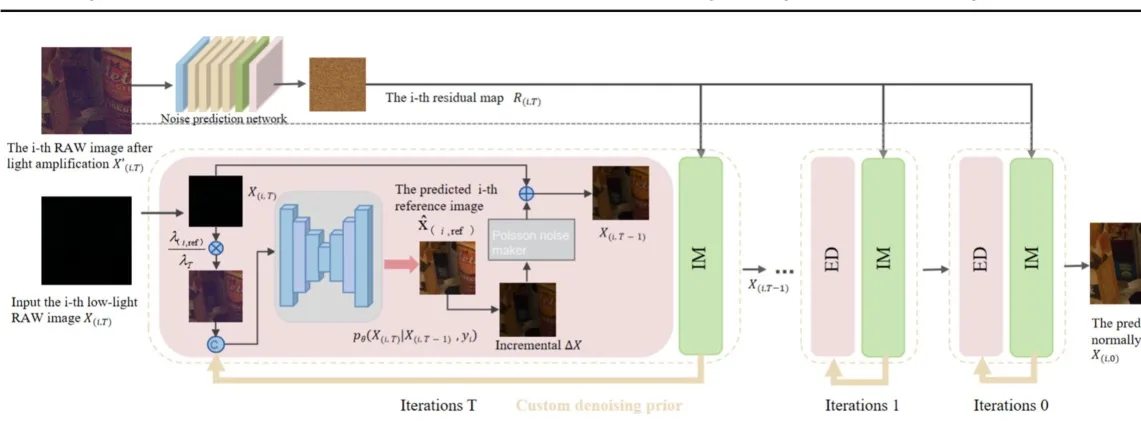
We propose a multi-task framework that jointly learns noise prediction and removal end-to-end, integrating a noise prediction network with an exposure diffusion model to provide a learnable denoising prior, achieving excellent results on the SID and ELD datasets.
摘要
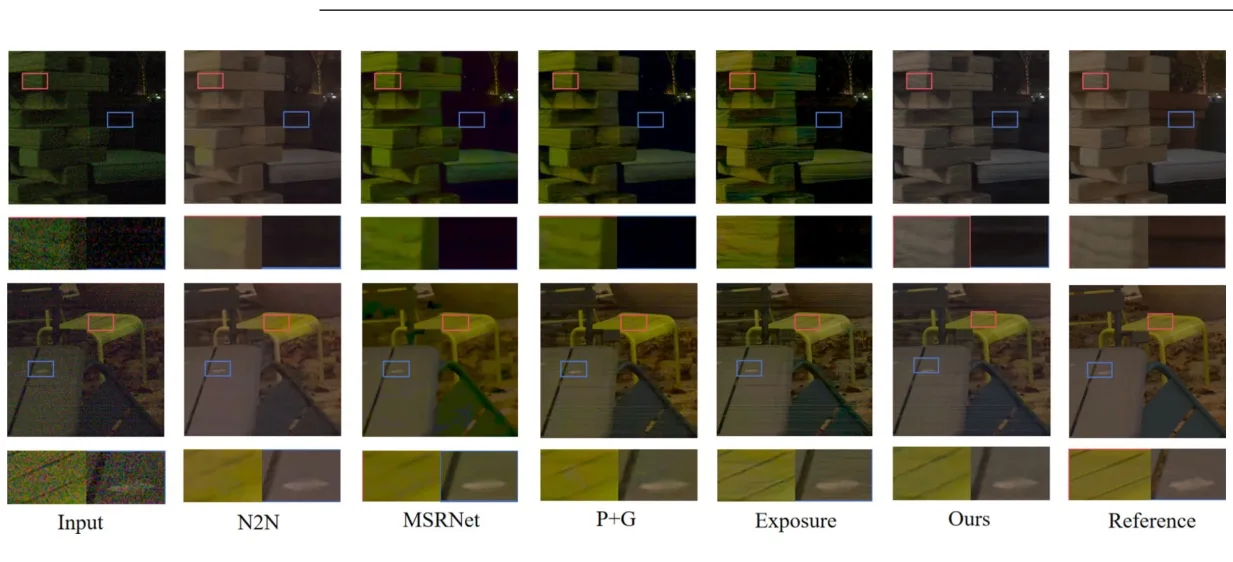
In most low-light RAW image enhancement methods, light intensity is amplified first, followed by denoising using deep networks or algorithms. However, noise in low-light environments has high-frequency characteristics and uneven distribution, leading to detail loss during denoising. By predicting noise, we can better distinguish between noise and details. In this paper, we propose a multi-task learning framework that jointly learns noise prediction and removal in an end-to-end manner, benefiting from the mutual enhancement between the tasks. Our framework integrates a noise prediction network into the exposure diffusion model. Compared to other denoising models, the diffusion model addresses content inconsistency in low-light images by incorporating stepwise diffusion and interaction between noise and details. Specifically, the low-light RAW image is passed through the noise prediction network to generate a residual map, which is then input into an interaction module to produce a denoising prior. This prior is fed into the exposure diffusion model for guided denoising, resulting in an image close to the ideal RAW image. Unlike traditional models that focus on noise diversity, our approach emphasizes discriminability in the diffusion process, making it more suitable for tasks requiring both diversity and precision. We achieved excellent results on the SID and ELD datasets.
主要结果
BibTeX
@article{han2025lrd,
  author  = {Han, Longfei and Wang, Mengzhen},
  title   = {Low-light image denoising with learnable diffusion prior},
  journal = {Signal, Image and Video Processing},
  volume  = {19},
  number  = {929},
  year    = {2025},
  doi     = {10.1007/s11760-025-04444-6}
}